Showing posts with label movies. Show all posts

Thursday, March 18, 2010

The Awesomeness that is Brian Blessed

Nearly two years ago, I commented on my desire to see Mr. Brian Blessed play the role of Thorin in The Hobbit movie.

Nice to know I am not the only one to fully appreciate Mr. Blessed's work.

Unfortunately, at least according to IMDB, some idiot casting director seems to think Ron Perlman makes a better fit.

Excuse me? Ron Perlman? RON "BEAUTY AND THE BEAST" PERLMAN?!?

I think I threw up in my mouth just a little bit there.

My hope for the adequacity* of this movie just dropped a bit as well.

I blame Guillermo del Toro for this. I doubt it would have happened if we had Peter Jackson at the helm. Yeah. I am one of those that thinks he did not due a half-bad job on the trilogy. I know a lot of hard-core fanboys have a problem with his vision of Middle-Earth. I did not think he did a bad job at all; in fact, I think he did a pretty dang good job.

But this atrocity is not, cannot be, and hopefully will never be, Thorin Oakenshield. Hellboy? OK. But he is not a dwarf. He is not Thorin Oakenshield, son of Thrain, King under the Mountain.

THIS is Thorin.

Or even this.


Heck, at this point I would even settle for Prince Vultan.

Yes. I went there.

Brian Blessed: he climbed Everest, played the Duke of Exeter in Henry V, and King Richard IV in Blackadder.

Now he deserves to be a dwarf.


(*adequacity: a term coined by WNYX's own Bill O'Neal.)

Tuesday, August 25, 2009

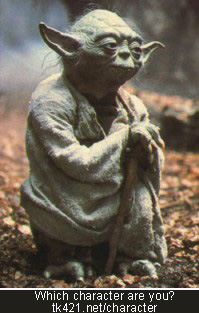
Which Character?


Yoda: A venerated sage with vast power and knowledge, you gently guide forces around you while serving as a champion of the light.

Judge me by my size, do you? And well you should not - for my ally is the Force. And a powerful ally it is. Life creates it, makes it grow. Its energy surrounds us, and binds us. Luminescent beings are we, not this crude matter! You must feel the Force around you, everywhere.

Yoda is a is a character in the Star Wars universe. More Yoda information is available at the Star Wars Databank.

Thursday, June 18, 2009

Simply Harry Potter

OK. I know that in my last post I may have indirectly heaped trash on the name of J.K. Rowling.

I swear I heard gasping, because there are so many for whom reading Rowling is nigh-unto worship.

That's why I have been reluctant to admit to you all that in the past nine days I re-read all seven Harry Potter novels. Yep. The entire series. Started on June 7 and ended last night.

It was an enjoyable little jaunt.

I am not going to take back my scorn, however.

And I am going to offend some people.

Yeah, I hear you saying that at least she's published. That people know who she is and who am I to criticize her. I understand all that.

I will admit the books are a somewhat pleasant diversion. But they are just that. There is no deeper meaning to them, although I am sure that the typical liberal-arts loving English professor could deconstruct them and find hidden meaning galore, if not The True Meaning Of Life. (Yes, capitalized even.) I tried last night as I was finishing up The Deathly Hallows. Surely there's a message there about learning the truth about your heroes, some warning to children not to look up to or trust adults, because there's always some hidden evil in their background. That was as close as I got, and if I am right -- if that was intended -- well then, J.K. Rowling should be ashamed of herself.

But see, I am of the opinion -- the STRONG opinion that these books are not children's books. I do not care what kind of marketing strategy or philosophy involved, these are not children's books. In fact, I am ready to argue that allowing a child to read some of these books may be akin to child abuse, or at least indifference to the child's mental/emotional welfare and well-being.

We will not discuss the movies, because I gave up caring after the second one.

But I remember being in a grocery store years ago and watching in disgusted amazement as a three-year-old child pointed at a Harry Potter balloon and called out "Harry Potter! Harry Potter!"

A three-year-old child has NO business knowing who Harry Potter is.

And I am not sure that anyone under the age of mid-teens should know either. My teenager has not read them yet, and has not suffered any ill effects. She may in fact be able to live without reading them; the jury is still out on that one, though. Some sudden attack of fatal lackofpotteritis may yet prove to be her undoing.

Do not get me wrong: I am not going to make the argument of witchcraft and sorcery being peddled to our young. Others have made this argument, that is their prerogative. My thinking? They are fantasy novels. Not reality. Heck, outside of my spiritual endeavors, I spend most of my life in a fantasy world. [Aside: What? You think lawyers are sane individuals fully functioning in reality? I beg to differ.] I cannot take too much umbrage with this point. After all, Gandalf did magic. So did Willy Wonka.

No, I have different issues with Ms. Rowling's works. First and foremost, there is very little pure good represented in the books. Pure evil? Sure, it is everywhere; it saturates her little universe and it pours off the page. But pure good? I challenge you to point to ten major characters that are examples of pure, unadulterated, unquestioned goodness in the novels. No fair using animals: Hedwig and the owls do not count. Neither does Fawkes. I'll start the list, though these should probably be qualified as supporting cast:
1. Hagrid. Hagrid is an innocent and I am hardpressed to remember any specifically bad intentional act. The other characters treat Hagrid with pity, in part because he just doesn't seem as smart as they are.
2. Arthur and Molly Weasley. Again, innocents without any memorable bad intentional act. Again, well-meaning, but portrayed as slightly pitiable or less-intelligent. In fact, I could probably lump Bill and perhaps Charlie Weasley in here as well, but they are even more minor characters than their parents and, as such, perhaps do not warrant inclusion in the discussion at all.
3. Luna Lovejoy. Possibly. Her name just came to me; I will have to reserve judgment unless and until I can remember any specifics. But here again, an innocent that everyone considers to be slightly off-kilter or insane (or stupid).
4. Professor Minerva McGonagall. Again, she just came to me. I will have to think on her. She may be an exception to this list, as she is strong and intelligent.
5. Neville Longbottom. Another innocent. Another slightly off-kilter, slightly less-intelligent member of the cast.

See a trend? The only arguably purely good characters in the books are those that are innocent, naive, and possibly not intelligent. That's a nice portrayal; nice message to send to kids. "Hey, son! Why can't you act more like Neville Longbottom, eh?"

No, the main protaganists -- and by this I mean Harry, Ron, Hermione, and Dumbledore -- none of these are as unequivocally good as Voldemort is unequivocally evil. The Dark Lord has no direct counterpart. Dumbledore has a dark side and has done bad things. Harry and Ron waffle back and forth; they are not examples of pure good. Harry's soul is certainly not as lily-white as Voldemort's soul is midnight-black.

After the whole "peddling-these-books-to-kids" issue, this is my main beef with the books. There is pure good in this world. There is also pure evil. If you are going to acquaint readers with evil, especially if you are going to market to children and acquaint impressionable children with the concept of pure evil, then you better darn well be willing and prepared to acquaint them with the concept of pure good.

Plus, I simply cannot accept these as "great" literature. They are pleasant distractions. They cannot -- no matter how loud the groundlings scream -- compare to Shakespeare. Dickens. Twain. Rand. Do not try and argue; one hundred years from now, two hundred? Will Harry Potter be remembered? Will he be taught in AP English classes? Who's to say? Perhaps our standards are indeed that low. They're already suggested reading in elementary school. [Aside: We actually considered a private school for our oldest when she was ready to start school. The fact that the classrooms displayed posters of Harry Potter and Star Wars actually helped convince us to homeschool. Yes, even with a Star Wars-nerd father. There has to be a line in Education. That is a rant for another day, though.] I hope our standards -- not just as Americans, but as a civilization as a whole -- are not this low; I truly hope not. If she is our day's Shakespeare, we may as well simply throw in the towel.

I hear you saying that Shakespeare wrote to entertain, to satisfy the groundlings. Yes, but he did so with style, skill, and art. While Rowling uses magic as a subject, there is little or no magic in her words. Want to argue? Give me a passage with as much feeling and meaning as these:
What a piece of work is a man! How noble in reason! how infinite in faculty! in form, in moving, how express and admirable! in action how like an angel! in apprehension how like a god! the beauty of the world! the paragon of animals! And yet, to me, what is this quintessence of dust?
The Bard distills the essence of what makes up a man: the inherent goodness. And he does so with skill, art, and brevity. In the approximately 3,000 pages of the series, she cannot make Harry -- or, truly, any character -- fit this profile, let alone describe anything with this manner of magnificent prose.

I have actually read a review saying, "This [the fact that the characters, good and evil, are developed in such a way that they are, well, not simply good or evil] is perhaps Rowling's greatest achievement in the book. While the series can be described as an epic tale between good and evil, the individuals involved are not so easily defined." This is said as PRAISE of the books. [Aside: what adds a twist to this review was that it came from socialistworker.org. And yes, it was a random search; I just happened across it. In fact, now that I think about it, there's a whole host of blog entries on the fact that self-proclaimed socialists thrill over the blurring of the lines between good and evil. But I will leave that for another day. I do not want to discuss politics right now.] Sure... it may be an epic tale between good and evil, but it is one without a heck of a lot of real good shining out.

In these dark times, do we not deserve to treat ourselves to a little real good now and then?

And do not our children also deserve it? In fact, is it possible that they deserve it even more?

I know, it's a work of fiction. Why am I getting so riled up?

In part because it is a work of fiction. It is not literature.

Rowling's books surely cannot be part of the works of the Ages. If they are, well, I guess we deserve what we get.

Thursday, November 13, 2008

NaNoWriMo 2008 - Update 2

Well, never let it be said that life cannot or will not intervene. I knew that November was going to be bad: busy bad, hectic bad, crazed bad. Here I am not even one-half way through and life has intervened whenever possible.

And my NaNoWriMo work is suffering for it.

As of bedtime last night (12:45 a.m. to be exact) I now find myself 7,716 words off-pace.

That's right. Just over four-and-one-half days behind (4.63--again, to be exact).

Life conspires to intervene. I thought I had planned well enough this year, even considering everything else going on in my life.

This is called, so I am told, "Adulthood."

Somehow, though, sitting at a desk wrangling legal issues through my brain all day makes me sufficiently tired and brain-deadened that when I arrive home I want nothing to do with the evil laptop sitting before me.

That's right. Evil.

EEEEEEE-vil. As in the froo-its of the Devil. (Thank you, Mike Myers.)

The blinking cursor mocks me.

The television goes on; I surf through ten channels of broadcast television. Nothing on. I surf through them again. And again. And again.

That's when my LW, who is also WriMo-ing, screams in frustration and tells me to turn off the television and write. She wants to inspire me, you know.

Of course, she's also 4,417 words ahead of me.

I try to read. Nothing satisfies; neither the sci-fi nor the fantasy novels on my nightstand interest me. The same with the biography. Ditto the history book. I even try the Scriptures...and find myself wondering how I could use some of the things I am reading and translate them into my novel.

That's not the best way to read the Scriptures, by the way. It is also not the best way or most conducive way to get anything out of them, learn from them, or feel the Spirit, necessarily.

That's when I start drinking: Soda, cola, water, lemonade, milk. Things of that nature. A few potato chips or peanuts to keep awake. Ultimately, I drag myself off to bed having written nothing.

Then there's the self-imposed guilt the next day. I think, "Where in my day could I steal an hour to pound out 1,000 words or so?" I feel guilty doing any work, thinking about how I could put that time to use on my NaNoWriMo word count.

Heck. I feel guilty even while writing this blog.

But life happens. Unfortunately, and despite our best laid plans. (Again, see "adulthood".)

(Now.... If I postponed two client meetings today until tomorrow, that's two hours I could have, all to myself....) Ahem. [cough cough]

UPDATE:
By the way, am I the only one that remembers the movie from which I borrowed the above picture? If anyone else can come up with the name of the movie, I would sincerely love to know about it, especially if you have actually seen the movie in question.

I think I am the only one of my friends that ever saw it, let alone enjoyed it. Talk about a movie geek. Sheesh.

Anyway, let me know if you know.

--Now back to working on my novel pleading.

UPDATE #2:

This is, by the way, 560 words that could have gone toward my NaNoWriMo. NOW who feels guilty, Hmmm?

Yep. Exactly.That's what I thought.

No one but me.

Wednesday, April 30, 2008

What have I got in my pocket?

The news is all over the 'net today--I got the word from E! Online

The acclaimed British thespian, [Sir Ian McKellen,] who, as the wizard Gandalf the Grey, helped shepherd Frodo Baggins through a perilous journey in Peter Jackson's The Lord of the Rings trilogy, has announced he will reprise his Academy Award-nominated role for the hugely anticipated Hobbit prequels.
I can breathe a sigh of relief now. NO-ONE could play Gandalf other than Sir Ian.

Word is, Andy Serkis has also signed up to reprise his role as Gollum.

Now...they just have to make sure and get Sir Ian Holm to once again don his waistcoat and come back as Bilbo Baggins. Like Sir Ian M. and Gandalf, I'm not convinced that any one else could pull off Bilbo.

While I'm glad that Peter Jackson and Fran Walsh will once again be involved, I certainly wish they were directing, rather than simply Executive Producers. I have heard rumors that they have negotiated EXTENSIVE control over script, etc., but until I see it, I won't believe it. It would take a special director to relinquish that kind of control to a producer, I think. Without that control--in fact, without Jackson at the helm--I'm not at all convinced that the Lord of the Rings magic can be repeated.

Now, Guillermo del Toro has agreed to direct. I haven't seen enough of his work to know whether or not I approve. I enjoyed Hellboy, but that's the only thing I've seen. I don't like subtitles, so I haven't seen Pan's Labyrinth and I do not think I've seen any of the other projects listed on his IMDB page. I WILL say that it couldn't be worse than the previously-rumored "Sam Raimi as director" potential.

Gaaak. Wouldn't that have been horrible?

I'll hold my breath and hope that del Toro and the Jackson/Walsh team can work some literary/cinematic magic. It would help to get the same visual effects and supporting crew from the Lord of the Rings movies. That's doubtful, however, because of the sour taste they're sure to have from prior dealings with New Line Cinema.

Which brings me to the riddle:
This thing all things devours:
Birds, beasts, trees, flowers:
Gnaws iron, bites steel:
Grinds hard stones to meal:
Slays king, ruins town,
And beats high mountains down!

[The answer: New Line Cinema's accounting department!]

Thank you, thank you...I'll be here all week. Try the veal and remember to tip the waitress.

There are all sorts of other jokes and one-liners sure to crop up now... "The marketing roads go ever ever on...."

We're also sure to see (another) re-issuing of the Rankin-Bass cartoons from the 1970s.

I didn't really enjoy those movies, but I KNOW for a fact that I'm not the only one humming the "Goblin Town" tune right now....

Admit it....

It could be worse.

You're welcome. THAT ear-worm will be with you for a while.

Bilbo... Bilbo Baggins... Bravest little Hobbit of them all...."

But if I could make two suggestions to the Producers and Director.

First, in re: casting:

There is one man out there that could fill Thorin Oakenshield's sky-blue hood with its long silver tassel:

Brian Blessed.

Yes, he of Blackadder fame. Yes, the same Brian Blessed that was in Branagh's Much Ado About Nothing.

He was also the voice of Boss Nass from Star Wars: Episode 1--The Phantom Menace.

And yes, also Prince Vultan from Flash Gordon.

Ahem.

We'll just ignore that last one, shall we?

Why Brian Blessed, you ask? Well... Mr. Blessed has a nice, booming voice, a morbidly-wicked sense of humor (at least, on screen), and I believe just the right temperament for the King Under the Mountain. I have long been a fan of Mr. Blessed's. His filmography (courtesy of IMDB.com) is quite impressive and varied: Dr. Who; Blake 7; The Avengers; I, Claudius; Henry V; MacGyver; Macbeth; King Lear; Waiting for Godot.

Wow.

So why not add Tolkien to that list?

His IMDB.com bio says: "Boisterous Brit Brian Blessed is known for his hearty, king-sized portrayals on film and TV. A giant of a man accompanied by an eloquent wit and booming, operatic voice[.]" There you have it: Hearty; king-sized; eloquent wit; booming operatic voice. (We'll ignore the "giant" part, as that can be addressed through visual effects.)

One last argument in favor: he's 4 inches shorter than John Rhys-Davies (a.k.a. Gimli).

My second recommendation: you simply MUST begin the movie with an introductory narrative as Jackson did in The Fellowship of the Ring. The Hobbit just would not be The Hobbit without

In a hole in the ground there lived a hobbit.
Not a nasty, dirty, wet hole, filled with the ends of worms and an oozy smell, nor yet a dry, bare sandy hole with nothing in it to sit down on or to eat: it was a hobbit-hole, and that means comfort.
It had a perfectly round door like a porthole, painted green, with a shiny yellow brass knob in the exact middle. The door opened on to a tube-shaped hall like a tunnel: a very comfortable tunnel without smoke, with panelled walls, and floors tiled and carpeted, provided with polished chairs.

This narrative could easily be matched with a visual tour of the hobbit-hole, as well as Hobbiton and various hobbits, much like Fellowship.

O.K. I'm getting too excited.

I'm going to stop here and go back to work.

Just as soon as I finish this next chapter of The Hobbit. Let's see...where was I?

Ah yes...
Bilbo had sniffed more than once at what he called 'all this dwarvish racket,' as they went along, though I don't suppose you or I would have noticed anything at all on a windy night, not if the whole cavalcade had passed two feet off.

Ahhhh...My precioussss....

Saturday, March 22, 2008

R.I.P.

Daisy, Daisy.... Give me your answer do....

A Grandmaster of Science Fiction died last week.

I thought about noting the passing of Sir Arthur C. Clarke at the time, but it's taken me this long to formulate my thoughts about him sufficiently to put into words.

I didn't really like his work.

Don't get me wrong, 2001: A Space Odyssey was an important movie in many ways. Who knows if we'd have Star Wars or Battlestar Galactica, or any of a dozen-plus other movies/series without it. I suppose it's also an important book, but I have to admit to two things: First, the movie--to me--is nearly unwatchable. I think I may have accomplished the feat twice (?). And second--again IMHO--the book is even more unreadable. I've heard that you have to read the book to understand the movied; maybe therein lies my problem with the movie.

I will agree, however, that the effects and editing in the movie are fantastic. The transition from a falling, rotating bone (humanity's supposed "first tool") to a (technically) falling, rotating space vehicle (humanity's supposed "latest tool") is still riveting. The rotating wheels, exercising in space, the velcro-shod stewardesses: all amazing and classic imagery.

And no-one can call themselves a sci-fi afficionado without professing a fascination with the HAL 9000. (Did you know that HAL's name was a play on "IBM," did you know that? One of the original Trivial Pursuit questions, I believe.) I have a 386 computer in the basement, the hard drive of which is loaded with HAL 9000 quotes and sounds.

And I have to admit to having carried a copy of The Hammer of God on my honeymoon. Loving books like I do, I go NOWHERE without one. My LW tolerates that habit of mine. (Even driving the Horde to the library, I will often have a book in the car, just in case I get stuck in the car waiting for them at the store, etc.)
That being said, The Hammer of God wasn't even cracked open until we returned home from the honeymoon. So there.

I found his Rama books somewhat entertaining, too.

That's about it.

However, I'm still a little upset by his death. I hate to see the Old Guard go. There's a LOT of bad modern science fiction out there now; much of it is even more unreadable than I consider 2001, and for different reasons. There's a lot of crap. Even some of the "big names" have fallen into the trap. A lot of the "hard" science fiction novels become a vehicle for the technology at the expense of a story. There is nothing wrong with intelligent science fiction, so long as there is a story as well.

The storytellers are leaving us and we're stuck with the merchandisers and the (pseudo-)intelligentsia.

Alas.

Sir Clarke did leave us with the satellite and the idea of the space elevator. And I believe he was, truly, a storyteller. I may not have liked a lot of what he did, but I have a lot of respect for what he did...and for his mind.

I doff my hat, bow my head, and wish he could tell us: is it, in fact, full of stars?

Goodbye, Sir.

We'll see you again on the other side.

Thursday, March 20, 2008

Constructive Thoughts: Ben Hur & Forgiveness

I am going to try and start a new repeating blog entry here, where I put voice to some of the ideas and thoughts I have during the Sabbath. Spencer W. Kimball, 12th President of The Church of Jesus Christ of Latter-day Saints, taught that "The Sabbath calls for constructive thoughts and acts." It is from that teaching, obviously, that I take the title for this repeating entry.
[for more information on President Kimball, start
here. ]
----------------------------------------
OK, so it's Thursday, but I've had this entry ready since Sunday.

It's a family tradition to watch Ben Hur on or around Easter each year. Well, we did so last night; the Horde loves to watch this genre: Ben Hur, Ten Commandments, Quo Vadis, etc.

While we're watching, my 7-year-old son says to me, "Dad, this scene [the chariot race] is just like the pod-racing scene in Star Wars." I looked at him in a little bit of shock, and agreed. "But Dad," he said, "this one's better, you know why?" I was intrigued and asked him why. "Because this one is real!" Out of the mouth of babes.

Anyway, as the movie ends, Charlton Heston Judah says to Esther, "Almost at the moment He died, I heard Him say, "Father, forgive them for they know not what they do." Esther responds with, "Even then." And then Judah says, "Even then. And I felt His voice take the sword out of my hand." This line hit me as it never had before.

[Aside: I must confess that I have never read this classic. I have two copies of Ben Hur: A Tale of the Christ in my library; one that I found in a used book store was printed in -- I believe -- 1898. I have started it, but to my shame, I did not make it very far before the hassles of life pulled me away from it. I have searched and searched, however, and do not believe this line from the movie was lifted from the book. I could be wrong, though.]

This line got me thinking and reminded me of two things right off the bat. First was a talk given last year in LDS General Conference by President James E. Faust. His talk was entitled "The Healing Power of Forgiveness." [Full text can be found here.] Near the end of the talk, President Faust gave the following counsel:
"When tragedy strikes, we should not respond by seeking personal revenge but rather let justice take its course and then let go. It is not easy to let go and empty our hearts of festering resentment. The Savior has offered to all of us a precious peace through His Atonement, but this can come only as we are willing to cast out negative feelings of anger, spite, or revenge. For all of us who forgive 'those who trespass against us,' even those who have committed serious crimes, the Atonement brings a measure of peace and comfort." [Citations omitted.]
It is not easy for the "natural man" to do this--casting out negative feelings of anger, spite, or revenge. It was not easy for Judah Ben Hur; I know it is not easy for me. I sometimes find myself harboring a grudge like a private little treasure--something I can pull out from time to time and revel in it. "My precioussss......"

It is easy to cast it out, however, if we have the proper attitude, the proper change of heart. You could see it in Judah: he had watched an innocent man receive cruel treatment--true torture--and death by crucifixion. He heard and felt the Savior's last mortal moments on Earth. It moved him and allowed him to forgive and forget his anger. The sword was taken--figuratively speaking--out of his hand.

The second thing that came to mind was a passage of scripture: Alma 24:6-17
6 Now there was not one soul among all the people who had been converted unto the Lord that would take up arms against their brethren; nay, they would not even make any preparations for war....
8 And behold, I thank my great God that he has given us a portion of his Spirit to soften our hearts....
12 Now, my best beloved brethren, since God hath taken away our stains, and our swords have become bright, then let us stain our swords no more with the blood of our brethren.
....
15 Oh, how merciful is our God! And now behold, since it has been as much as we could do to get our stains taken away from us, and our swords are made bright, let us hide them away that they may be kept bright, as a testimony to our God at the last day, or at the day that we shall be brought to stand before him to be judged, that we have not stained our swords in the blood of our brethren since he imparted his word unto us and has made us clean thereby.
16 And now, my brethren, if our brethren seek to destroy us, behold, we will hide away our swords, yea, even we will bury them deep in the earth, that they may be kept bright, as a testimony that we have never used them, at the last day; and if our brethren destroy us, behold, we shall go to our God and shall be saved.
17 And now it came to pass that when the king had made an end of these sayings, and all the people were assembled together, they took their swords, and all the weapons which were used for the shedding of man's blood, and they did bury them up deep in the earth.
They too had felt the power of His word, they were changed by His word, and they had the sword taken out of their hands not just figuratively changed, but literally taken from their hands. They buried their swords and other weapons in the face of an approaching army. His voice gave them the courage and the peace of heart to do so. His voice gave them a change of heart.

I need that. I need to feel that. As I have gone back and read over President Faust's words again, I was struck by another passage. He said,
"If we can find forgiveness in our hearts for those who have caused us hurt and injury, we will rise to a higher level of self-esteem and well-being. Some recent studies show that people who are taught to forgive become 'less angry, more hopeful, less depressed, less anxious and less stressed,' which leads to greater physical well-being. Another of these studies concludes 'that forgiveness...is a liberating gift [that] people can give to themselves.'" [Citations omitted.]
I need that in my life. I need more self-esteem, more well-being, less anger, more hope, less depression, anxiety, and stress.

I need to be forgiven.

We need to forgive to be forgiven.

So, I need to let go of some things.

It may be a long list when I get through, but it's a list that needs to be made.

It may not be easy, but it is necessary.

And it needs to start now.